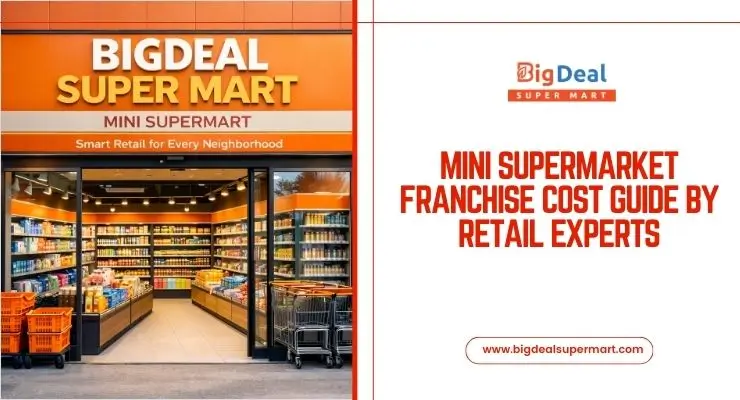
Mini Supermarket Franchise Cost Guide by Retail Experts
The cost of starting a grocery store business and why BigDeal Supermart franchise is becoming popular.
Supermarket business is expanding rapidly into the Indian retail ecosystem.
As much as the shopping malls and hypermarkets receive coverage, mini supermarket franchises are emerging as more attractive to both new franchisees and long-term investors because they are small grocery store business outlets that serve customers in neighbourhoods.
The model, with reduced initial investment, lean operations, and high demand of necessities every day, is developing into a savvy access point to the formalized retail franchise store environment.
Here, we disaggregate every expense you are likely to incur when setting up a mini supermarket, with 500 sq ft.
We shall discuss investment elements, operating expenses, break-even hopes, investment plans, and the ease with which recognized models such as the BigDeal Supermart Franchise make the process easy.
What is a Mini Supermarket Franchise?
Mini supermarket franchise is a small, branded, grocery store type of venture, usually placed between 500-1500 sq ft, that aims to offer daily needs to households in residential areas or within semi-urban markets.
Contrary to a classic kirana store, it has under a structured retail system where shelves are well arranged, there is a barcode billing, inventory mechanism and brand supported supply chains.
This model combines both the convenience of a local store and the professionalism of an organized supermarket business.
It provides customers with access to staples, FMCG goods, packaged foods, beverages, personal care products, and occasionally fresh produce in a clean and standardized retail setting.
The mini supermarkets that are franchise based are on the increase since they lessen the risk of starting up a distinct grocery store. One industry observation makes it clear:
In both urban and Tier-2 markets, organized retail formats are steadily supplanting unstructured grocery stores as consumers prefer hygiene, transparency and a consistent price.
The developing food retail store environment of India provides franchise store systems, in which brands such as BigDeal Supermart are providing training, vendor tie-ups, branding and back-end support.
This provides a more structured and scalable entry into the retail franchise outlet segment.
Reasons Why This Model Is Desirable To Entrepreneurs
- Reduced investment relative to full scale supermarkets
- Shorter establishment schedule (can be as short as 30 days 60 days)
- Merchandising and standardized branding
- High day-to-day demand of groceries (recession-resistant category)
- Franchisor inventory and sourcing
A mini supermarket franchise of 500 sq ft is a golden mean — small enough to manage, but big enough to provide a range and draw consistent traffic.
Also Read: Step-by-Step Guide to Mini Supermarket Investment
Cost Elements of a 500 sq ft Mini Supermarket
Starting a 500 sq ft mini supermarket needs financial planning. Although the total investment depends on the city and brand in question, it is worth knowing the cost structure so as you can budget effectively.
| Components | Estimated cost |
| Franchise fee | 2.10 lakh + 18% GST |
| Store set up and interiors | 3 lakh – 8 lakh |
| Initial inventory | 2.5 lakh – 5 lakh |
| Technology and equipment | 0.5 lakh – 2 lakh |
| Working capital | 6 lakh – 8 lakh |
| Total Investment | ₹13 lakh – ₹29 lakh |
The most important cost elements are listed below:
1. Franchise Fee
This is an advance that is paid to the franchisor over:
- Brand usage rights
- Operational support
- Training
- Initial support
This may cost 2 lakh to 10 lakh or above depending on the brand.
2. Store Setup & Interiors
This comprises physical infrastructure and visual merchandising:
- Wall & gondola racks
- Billing counter
- False ceiling & lighting
- Store signage & branding
In a 500 sq ft area, interior furnishing typically costs start at ₹3 lakh to ₹8 lakh, based on the quality of the finish and the costs in the city.
3. Initial Inventory
One of the most important investments in a grocery store business is inventory.
Stock typically includes:
- Staples (rice, wheat,pulses, oil)
- Packaged foods
- Dairy & beverages
- Snacks & confectionery
- Personal care items
The start-up stock of a small supermarket enterprise could have ₹1.5 lakh 5 lakh as per assortment depth and supplier credit terms.
4. Equipment & Technology
Contemporary retail franchise stores need effective stock management and billing system:
- POS system
- Barcode scanner
- Weighing scale
- Fridge/freezers (in case of selling dairy/frozen products)
- CCTV cameras
Estimated range: ₹50,000 – ₹2 lakh.
5. Licenses & Legal Compliance ( optional)
The food retail store needs to be registered:
- FSSAI license
- GST registration
- Local municipal trade license
- Registration of Shop and Establishment
These are minor expenses as compared to infrastructure but are required in order to operate smoothly.
6. Working Capital (2-3 Months Buffer)
Lots of novice franchise owners under-calculate working capital. You’ll need cash reserves for:
- Staff salaries
- Utility bills
- Inventory replenishment
- Rent
- Marketing expenses
In most cases, 1 lakh to 3 lakh must be held as buffer.
7. Marketing & Launch Promotion
Local pamphlets, banners, and social media promotions are assisted by the grand opening discounts to generate initial footfall. Budget around ₹10,000 – ₹50,000.
Estimated Total Investment Bandwidth
The overall investment in a mini supermarket franchise (500 sq ft) is usually between:
₹13 lakh – ₹29 lakh
(based on city, rental structure/owned property, and scale of inventory)
Franchise Snapshot: The Big Deal Supermart
BigDeal Supermart is one brand that is carving presence in the supermarket franchise industry of India.
Big Deal Supermart is a brand-assisted retail franchise model that aims at enabling individuals to establish successful grocery store companies.
Its model incorporates continuous operational support, brand credibility, supply chain integration and marketing support.
Major Big Deal Franchise Considerations:
- Unit models of franchise investing usually cost between ₹10 L to ₹20 L depending on size and location.
- Tools and onboarding of a franchise seek a rapid release (usually against a time horizon of around 45 days).
- Others include training, access to the supply chain, marketing tools and in certain models, inventory planning systems.
- Franchise contracts typically have a life span of several years, which gives predictability and perpetuation (usually 5 years).
Franchise systems such as the Big Deal alleviate most of the standard startup overheads of new retail clients, including supplier networks, branding engines, and customer rewarding engines.
Revenue and Profitability Expectation
A mini supermarket franchise works on a high volume low margin model. In contrast to luxury retail, profitability of a grocery store business is based on the daily necessities, returning clientele, and recreational inventory turnover.
1️. Typical Monthly Revenue (500 sqft Outlet)
A retail franchise outlet with 500 sq ft, well-situated, retail store in a residential area:
- Average Daily Sales: ₹8,000 – ₹15,000
- Monthly Sales Potential: 2.5 lakh – 4.5 lakh
There is a high possibility of high-density urban areas touching 5-6 lakhs monthly in terms of high brand recall and product mix.
2️. Gross Margins Supermarket Business
Margins vary by category:
- Staples & FMCG: 10–18%
- Packaged foods & snacks: 15–25%
- Private label products: 20–35%
- Personal care: 18–30%
Average mini supermarket franchise has a mixed gross margin of 18-25 percent, depending on mix.
Inventory velocity is more of a driver to profitability in neighborhood supermarkets compared to high markups.
3️. Sample Monthly Profit Snapshot (Representative)
| Item | Approx Monthly(₹) |
| Sales | 3.5 lakhs |
| Costs of Goods Sold | 2.62 lakhs |
| Gross Profit | 87500 |
| Operating Costs (Rent + Salaries + Utilities) | 55000 |
| Estimated Net Profit | 32500 |
Margins can be further enhanced with better product mix and better terms of supplier credit.
4. Factors That Enhance Profitability
- Stocking special items and nudges close to billing
- Emphasis on own brands
- Vendor credit (negotiated 15-30 days)
- Smaller wastage and shrinkage
- Return and repeat customer satisfaction
Such brands as BigDeal Supermart usually assist with inventory management and central procurement so that franchisees can maximize their margins and minimize sourcing inefficiencies.
Break-Even & Return on Investment
1. When Can You Break Even?
A 500 sq ft mini supermarket franchise with an investment of 10-15 lakh (worth):
- Average net monthly profit: ₹25,000 – ₹60,000
- Anticipated break-even time: 12- 24 months
Low traffic places can reduce this to 10-15 months, whereas the slower markets can require up to 30 months.
2️. ROI Outlook
When the outlet generates 40,000 net per month on average:
- Annual net profit ≈ ₹4.8 lakh
- On 12 lakh investment:.i.e. 40% annual ROI (After stabilization)
However, real ROI depends on:
- Rental structure
- Inventory turnover rate
- Local competition
- Operational efficiency
3. Beyond Year 1
Numerous supermarket franchisors enjoy greater profitability following:
- Developing a loyal customer base
- Product diversification
- Frozen segments or fresh produce
- Introducing online ordering / WhatsApp delivery
Since demand in the grocery business is repeated and recession-proof, once the business attains operational stability, the income is expected to be predictable.
Check out this: GST/FSSAI Compliant: Complete Supermarket Franchise Launch Roadmap
Conclusion
One of the most viable and scaled entry point to the organization grocery store business is a Mini Supermarket Franchise in a 500 sq ft format.
This retail franchise outlet model includes moderate level of investment, daily-need products, and structured support of the back-end systems that binds manageable risk and steady income potential.
There are three pillars of success, though:
✔ Smart location selection
✔ Strong inventory turnover
✔ Operational discipline
With proven systems and brand reputation – as exemplified by models cited through the framework that the Big Deal Supermart provides – franchisees are in a better position to minimize sourcing challenges, stream operations and speed-up profitability.
Although supermarket business margins are not as explosive, the constant demand of food retail stores generates financial stability in long-term. Planned well, most outlets expect to break-even after 12-24 months and then establish sustainable monthly revenues.
Ready to open your mini supermarket franchise?
When thinking about venturing into grocery retail:
- Assess your investing ability
- Evaluate the places with high traffic
- Compare franchise store models
- Ask shortlisted brands to provide a breakdown of their cost
Get on the next step today research available franchise opportunities, talk to Big Deal Supermart franchise owners, and ask them to provide a more customized estimate of the investment.
With a carefully thought out mini supermarket franchise, the scope of your potential franchisee growth is a reliable, community-based retail business with long term growth potential.
FAQs
1) What is the minimum capital investment necessary to open a Mini Supermarket Franchise?
When it comes to a 500 sq ft system, the overall investment cost lies between 8 lakh to 25 lakh, based on brand, location, cost of rent and scale of stock. Franchise stores with brands might demand more investment, because they are organized and supplied.
2️) What is the profitability of a grocery store business?
The average gross margin of a mini supermarket franchise is 18-25 percent. Rent, salaries and utilities allowed a range of 25,000-60,000 within net monthly profits, based on level and operational effectiveness of sales.
3) What is the break even period?
The majority of businesses within the category of 500 sq ft supermarkets hope to break-even in 12-24 months. The best place with high pedestrian traffic and good inventory control can recover more quickly.
4️) What is more advantageous an independent store or a franchise store?
Brand recognition, access to supply chains, training, and operational support are among the benefits of a franchise store. Independent grocery stores are more flexible, although you would need to establish vendor networks, branding, and systems. Most novice entrepreneurs focus on reduced risk models such as the Big Deal Supermart.
5) What are the licenses needed to start a food retail store?
You will generally need:
- FSSAI license
- GST registration (where necessary)
- Local trade/municipal license
- Shop & Establishment registration
The compliance takes care of the smooth operations and aversion of penalties.