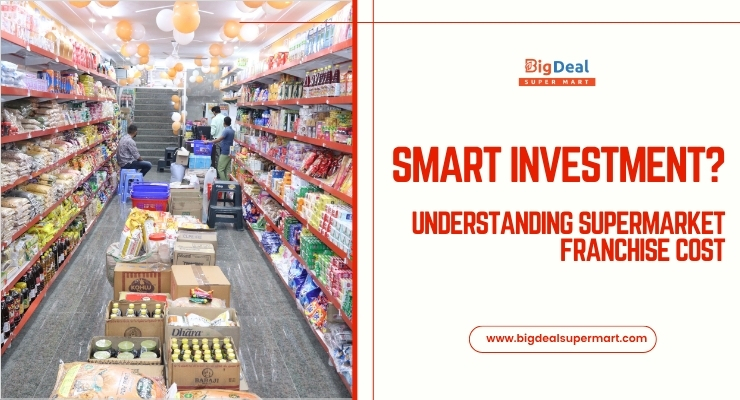
Smart Investment? Understanding Supermarket Franchise Cost
Introduction
Increasingly, entrepreneurs are seeing supermarket franchises as a fair business opportunity in the evolving Indian retail industry.
These retail models had well-established brand names, proven business structures, and supply chain access, all of which would take a whole lot of years to build on one’s own.
And yet, one question is always in the air during any boardroom discussion and such meetings with investors: What is the actual supermarket franchise cost?
One has to understand the full scope of the investment in setting up a supermarket franchise.
Some may consider only the franchise fee or setup cost while the total commitment is far more huge—infrastructure and inventory, staffing, local licenses, royalties, and many other things.
Investors or small businessmen who are anyhow planning for returns and sustainability, in the long run, should not only break down the supermarket franchise cost itself-It should be a must.
We shall now throw some light on what accounts for the cost, on the expected returns from this investment, and whether or not investing in the supermarket franchise would be profitable for 2025 ahead.
Read More: Investing in Small Retail: Mini Supermarket Franchise Costs
What Constitutes the Supermarket Franchise Cost?
To begin with, it is crucial to understand that the supermarket franchise cost does not come as a one-time number in a pamphlet- rather, it constitutes different financial commitments spread all through the start-up and operational phases.
1. Franchise Fee
This refers to the amount payable to the franchisor before entering into the rights for their brand name, trademarks, and operating systems.
This fee generally lies between ₹2 lakhs and ₹30 lakhs, depending on the market positioning and scale of the brands.
The more elaborate supermarket chains with national or international recognition would charge more.
2. Infrastructure and Setup
The rent or purchase of retail space; renovations; store fixtures; point-of-sales systems; air-conditioning; signage; lighting; racks for storage; and security systems all go under this bucket.
The location holds great significance in a metro city and can be nearly two times the cost compared to a Tier 2 or a Tier 3 city.
This cost generally starts around ₹8 lakhs for small supermarkets and can go beyond ₹1 crore for bigger stores.
3. Initial Inventory
An essential part of the supermarket franchise cost is the initial inventory cost.
The first investment must compensate for stocking groceries, perishables, FMCG products, and non-perishables in smaller supermarkets costing between ₹5 lakhs and ₹40 lakhs, depending on store size.
Planning for inventory right at the start is also essential to avoid overstocking and spoilage.
4. License and Regulatory Expenses
There are many licenses that a supermarket owner requires to be able to conduct his business structure legally.
These include FSSAI, GST registration, local trade license, fire safety clearance, and Shops and Establishments Act license.
Each of these licenses is not very expensive individually but cumulatively is worth between ₹50,000 to ₹2 Lakhs and these costs are part of the investment training.
5. Hiring and Training
The human resources of the store are critical to its success.
The franchisor may share some training costs, but recruiting full-time and part-time employees; purchasing their uniforms and initial salaries; and conducting background checks will be at your expense.
Initial staffing costs for a medium-sized supermarket with night shifts or extended business hours will be from ₹1.5 lakhs to ₹5 lakhs per month.
6. Marketing and Promotion
Branding, printing of handouts, printing, advertisements, launch activities, and engagements still cost a substantial amount of money.
Local marketing is essential regardless of whether the brand has name recognition or not.
Initially, plan for at least ₹1 lakh to ₹5 lakhs, then further plan to set aside a marketing budget monthly to keep the marketing campaigns afloat.
7. Royalties and Revenue Sharing
Almost all supermarket franchising bodies take up a continuing royalty charge, commonly 3 to 8% of the gross revenue.
This recurrent item of the supermarket franchise cost should be included in calculating your break-even and profitability forecasts.
Supermarket Franchise Cost by Tier
An approximate breakup of likely investment sizes based on scale is as follows:
- Mini supermarket: ₹10 – ₹30 lakhs
- Standard supermarket: ₹30 lakh – ₹80 lakh
- Hypermarket franchise: Above ₹1 crore
Brands such as BigDeal Supermart and Spencer’s Retail may differ in store sizes; hence, cost structures have a wide range.
Is It Worth the Cost?
Every business investment should be weighed against potential returns.
Depending on footfall, brand acceptance, and neighbourhood competition, a supermarket that is well-located and well-run starts giving extraordinary returns within 18 to 30 months.
Grocery retail has thin gross margins (around 10-20%), so volumes and operational efficiencies matter the most.
This is why understanding what a supermarket franchise cost from the beginning is important- it helps you don the long-term planning hat.
Furthermore, most entrepreneurs feel that the franchisor’s benefits, such as made-to-order supplier arrangements, personnel training, IT assistance, and brand credibility, most certainly outweigh the few disadvantages of high upfront investments.
Also, grocery continues to stay among the recession-proof sectors in India.
Key Factors That Influence Supermarket Franchise Cost
The starting or running a supermarket franchise cost will vary with some specific variables. Let us dive in a bit more deeply:
Location
Real estate cost for leasing or buying property differs dramatically between cities. Setting up a 1500 sq. ft. store is five times costlier in Mumbai than in Bhopal.
Supermarket franchise cost must consider the local real estate trends and the population density.
Store Size
Are you talking about a mini market or a 5,000 sq. ft. hyperstore? That makes a world of difference.
As the size increases, so does operating cost—big outlets mean more power, employees, security, and inventory are needed.
Brand Selection
The brand you select may bear higher franchise fees but this could lead to faster returns because of professional-name recognition.
This will, in turn, increase the upfront supermarket franchise cost.
On the other hand, smaller brands or regional brands may be cheaper but more marketing efforts are required to create visibility.
Format and Model
Some franchisors have different models: company-owned company-operated (COCO), franchise-owner franchise-operated (FOFO), or franchise-owner company-operated (FOCO).
Each ownership has a different cost-sharing arrangement.
FOFO is the most common; where the investor bears the supermarket franchise cost and runs the operations on their own.
ROI Breakdown: What You Can Expect
Understanding returns is crucial. Margins are typically thin, but a high-volume business like a supermarket generates steady and recurring revenue.
A generic breakup of ROI looks something like this:
- Monthly Revenue: ₹6 to ₹20 lakhs (depending on store size and location)
- Net Profit Margin: 8%–12%
- Monthly Net Profit: ₹50,000 to ₹2 lakhs
- Break-even Point: 18 to 30 months
- Annual Return: 12% to 25% after break-even
These figures will naturally fluctuate but give something of a yardstick.
Remember, profits are not immediate in most cases but if managed well, this can be a long-term wealth-generating venture.
What to Ask Before You Invest
Here are some questions to consider when assessing supermarket franchise cost that will help you decide:
- What is the overall investment, including hidden and ongoing costs?
- Is there marketing, tech, and operational support from the brand?
- How soon can I expect to recover my investment?
- How much flexibility do I have with pricing or sourcing?
- Can I contact active franchisees?
Conversations around these points with the franchisor will provide clarity on what exactly you are committing to.
Frequently Asked Questions
Q1. What’s the typical cost of setting up a supermarket franchise in India?
This price ranges from anywhere between ₹10 lakh for small models to ₹2 crore, depending on the brand, size, and location of the store.
Q2. Can I get financing for my supermarket franchise?
Yes. Banks do offer business loans or franchise financing for prominent market players.
Q3. Are operating costs fixed or variable for a supermarket franchise?
Except for the franchise fees which are usually fixed; costs such as infrastructure, inventory, and operations are variable ones, depending on the state of the market and other business choices.
Q4. How much can one expect to earn from a supermarket franchise?
Maintaining fairly heavy footfalls and being strategically placed in conjunction with good brand support can keep the income stream flowing steadily for supermarket franchises, which break even within two years.
Q5. What expenses shall I expect to keep on incurring?
In addition to royalties, there are also rent, employee wages, utilities, software maintenance expenses, inventory replenishment, and local advertising.
Check out this:
The Bigger Picture: Is It Smart?
With urbanization, rises in disposable income, and a taste for organized retail on the rise, the Indian supermarket landscape has been expanding at a very rapid rate.
Franchises reduce the burden of brand building, offer pre-negotiated supplier contracts, and furnish systems that diminish operational friction.
Still, you must treat the supermarket franchise cost as a strategic business investment rather than a mere transaction.
It is not just buying into a name—it’s about sustaining that investment, nurturing it, and scaling it eventually.
The cost, if planned well and market studied well along with wise brand selection, is more than justifiable; it is the foundation for building a business in the long run.