Grocery Mart Franchise in India: How to Choose and Manage for Maximum Profit
Quick Answer
A grocery mart franchise in India can be opened for ₹13 lakh (Mini Mart) with BigDeal Supermart, with zero royalty and a 45-day launch timeline. To choose the right franchise, evaluate the royalty model, supply chain strength, training support, and territory rights. To manage it profitably, focus on inventory turnover, staff accountability, local marketing, and weekly sales data review. Apply for a franchise.
Introduction
Starting a grocery mart franchise in India is one of the clearest paths to business ownership available to a first-generation entrepreneur today.
Grocery is a daily necessity, the market is large, and the shift from unorganised kirana stores to branded organised retail is happening fast across every city tier in India.
But two questions stop most aspiring franchise owners before they start: which franchise is the right one to choose, and how do you actually manage it to generate consistent profit once it is open? Both questions have clear, practical answers and both are covered in detail on this page.
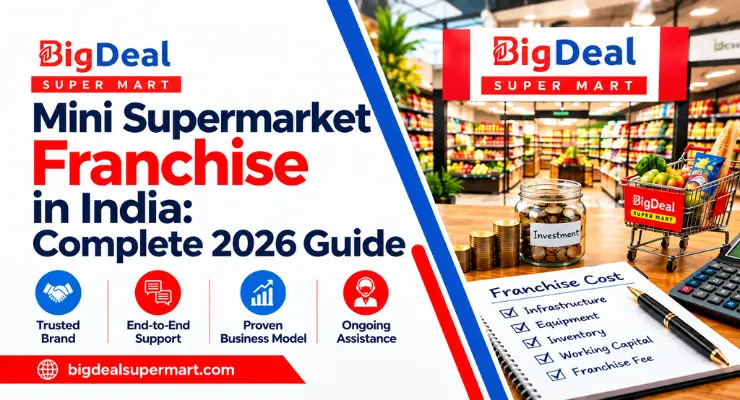
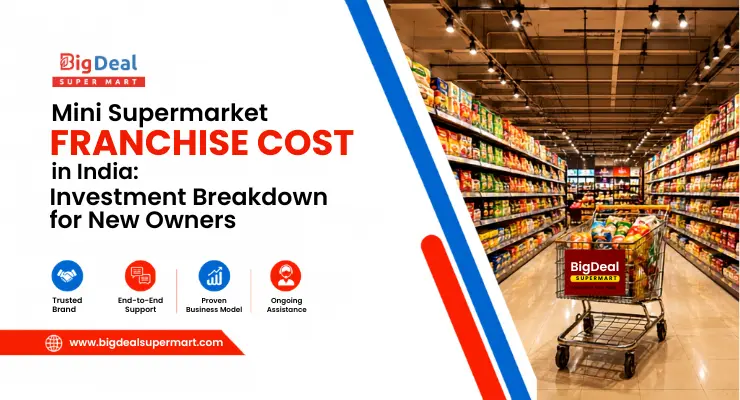
Before reading further, see the full investment cost breakdown for each BigDeal store format.
Understanding the investment numbers before evaluating any franchise makes every other decision easier.
Why a Grocery Mart Franchise Makes Sense in India Right Now
India’s grocery retail market is valued at over ₹60 lakh crore and growing at approximately 10% per year. The organised retail segment – supermarkets, chain grocery stores, and franchise outlets – currently accounts for less than 12% of total grocery sales. That means 88% of grocery purchases in India still happen through unorganised kirana stores.
This gap is closing rapidly. Urban consumers increasingly prefer organised stores for monthly grocery shopping because of predictable pricing, branded product assurance, and the convenience of finding everything in one place. In Tier 2 and Tier 3 cities, where large organised retail chains have limited presence, a well-run grocery mart franchise has a clear competitive advantage with very little direct competition.
What the Market Shift Means for Franchise Owners
Every kirana store that a consumer switches to organised retail is a permanent customer gain for the nearest branded grocery franchise. Once a consumer makes the switch based on a better shopping experience, they rarely return to unorganised retail for their primary grocery needs. This means early franchise owners in a locality capture customers for years, not months.
India’s FMCG sector is forecast to reach ₹18 lakh crore by 2030 according to IBEF, with organised grocery retail expected to grow its share to over 25% by the same period. Franchise owners entering now are entering a market still in its growth phase, not at saturation.
Franchise Vs Independent: What the Numbers Say
The most common alternative to a grocery mart franchise is opening an independent grocery store. On paper, independence looks attractive: lower upfront cost, no franchise fee, and full control over every decision. In practice, it carries risks that consistently undermine independent stores in their first two years:
- Independent stores negotiate supplier pricing individually, paying 8–18% more per unit than a franchise network with centralised procurement.
- They build brand recognition from zero, which typically takes 18 to 36 months to reach meaningful customer loyalty.
- They source, pay for, and maintain their own billing and inventory software
- They have no external performance review, which means operational inefficiencies go uncorrected for months.
A franchise with a strong franchisor eliminates all four of those problems on Day 1. The franchise fee is not a cost – it is the price of skipping two to three years of trial and error.
How to Choose the Right Grocery Mart Franchise in India
Not every franchise in India offers the same terms, support, or business model. Choosing the wrong partner costs you time, capital, and market position. These are the criteria that separate a good franchise from a poor one.
Five Questions to Ask Before Signing Any Franchise Agreement
1. Is there an ongoing royalty, and how much is it?
Some franchise brands charge 3-6% of monthly revenue as an ongoing royalty. On ₹7 lakh monthly revenue, that is ₹21,000-₹42,000 per month leaving your account regardless of your profit margin. Over 3 years, that is ₹7.5-₹15 lakh paid to the franchisor from your earnings. Ask for the royalty clause in writing before any discussion about investment amounts.
2. What territory rights does the agreement give you?
Without exclusive territory rights, the franchisor can open another franchise partner’s store in the same locality – directly competing with you for the same customers. Ask for the exact boundary of your protected territory, get it written into the franchise agreement, and confirm that BigDeal operates on an area-code system that prevents overlap.
3. Who are the suppliers, and can you see the pricing?
The quality of a franchise’s supply chain determines your margins. A strong franchisor has direct agreements with FMCG manufacturers at preferential rates. A weak franchisor routes your orders through middlemen at retail-level pricing, eliminating your margin advantage. Request a list of key suppliers and ask whether rates are fixed or variable.
4. What training do you receive before and after opening?
Pre-opening training covers store operations, billing, inventory management, and staff management. Post-opening support covers quarterly business reviews, marketing campaigns, and operational troubleshooting. A franchisor that offers only pre-opening training gives you the brand but not the system. Ask for a written description of the support model.
5. How many active franchise partners are running the brand?
Ask the franchisor to connect you with 2–3 existing franchise partners for a direct conversation. Partners who are profitable and well-supported will speak positively and specifically about their experience. Vague answers, reluctance to provide references, or partners who describe poor support are clear warning signs.
Why BigDeal Supermart’s Zero-Royalty Model Changes the Numbers
BigDeal Supermart charges zero ongoing royalty on all three store formats. The franchise fee is paid once, at signing. Every rupee your store earns above its operating costs belongs to you. Compared to a competing franchise charging 4% royalty on ₹6 lakh monthly revenue, a BigDeal franchise partner retains an additional ₹24,000 per month – ₹2.88 lakh per year – without any change in operations.
| Zero royalty is BigDeal Supermart’s most important differentiator.
At ₹6 lakh monthly revenue with a 4% royalty competitor, you pay ₹24,000/month in royalty. At zero royalty with BigDeal, that ₹24,000 goes directly to your net profit. Over 36 months, the difference is ₹8.64 lakh. |
Red Flags That Should Stop You From Signing
| Stop and reconsider if a franchise agreement includes any of these:
✗ Monthly royalty above 3% of revenue with no performance floor ✗ Minimum purchase obligations that force you to buy slow-moving stock ✗ No exclusive territory clause ✗ Training limited to 3 days or fewer ✗ No written commitment to post-opening support ✗ Undefined refund terms if the agreement is terminated early |
Which Format Should You Open: Mini Mart, Super Mart or Hyper Mart?
BigDeal Supermart offers three store formats. The right choice depends on your investment capacity, target location size, and business experience. Here is a direct comparison:
| Format | Store Size | Investment Range | Best Location | SKU Count |
| Mini Mart | 500–1,000 sq ft | ₹13–23 lakh | Residential colony, Tier 2/3 town | 2,000–4,000 |
| Super Mart | 1,000–4,000 sq ft | ₹23–83 lakh | Urban locality, apartment complex | 4,000–10,000 |
| Hyper Mart | 4,000–10,000 sq ft | ₹83 lakh–₹2.3 crore | Commercial area, main market, mall | 10,000–20,000+ |
| Royalty (all formats) | – | ₹0 | Zero on all formats | – |
For first-time investors, the Mini Mart is the recommended starting format. The investment is within reach of most middle-class entrepreneurs without requiring a large bank loan. The operations are manageable with 3-4 staff. And the break-even timeline – 12 to 18 months in a good location – is predictable.
Investors with higher capital and prior business experience should evaluate the Super Mart format seriously. The ₹23-83 lakh investment supports a much wider product range, higher average transaction values, and greater monthly revenue. Many Super Mart franchise partners report gross monthly revenue of ₹10-25 lakh in well-located urban stores.
How to Manage Your Grocery Mart Franchise for Higher Profits
Choosing the right brand gets you started. Managing it well is what keeps your store profitable in month 24 and beyond. The difference between the store that breaks even at month 12 and one that breaks even at month 30 is almost always management quality – not location, not brand, and not the franchisor’s support.
Inventory Management: The Most Important Daily Task
In organised grocery retail, your profit margin is set at the time of purchase. You buy at a supplier price, sell at a retail price, and the difference is your gross margin. Protecting that margin requires tight inventory control on three fronts:
- Avoid overstocking slow-moving items. Dairy, fresh produce, and packaged snacks with short shelf lives tie up your working capital if ordered in excess. Track which items are selling in your specific locality – not what the national average suggests. A BigDeal franchise’s billing software shows you weekly movement data for every SKU
- Never let fast-moving items go out of stock. An empty shelf costs you more than overstocking. When a customer does not find a staple like rice, cooking oil, or a popular biscuit brand, they go to a competitor. Restocking alerts in your billing system should be set at a minimum of 5–7 days ahead of projected stock-out
- Conduct weekly physical stock audits. Billing software tracks what was billed, not what is physically on the shelf. Shrinkage – whether from breakage, staff pilferage, or billing errors – is invisible unless you compare your system inventory with your physical count weekly. Reconcile the difference every Monday morning
Staff Management and Customer Service Standards
- A grocery store with 3 staff members is a customer service business as much as a retail operation. How your staff behaves when a customer cannot find a product, when the billing queue is long, or when a product return is requested determines whether that customer comes back. Set written standards, not verbal instructions. A staff handbook that defines greeting behaviour, billing speed standards, complaint handling steps, and end-of-day closing procedures ensures consistency regardless of which staff member is working that day
- Implement a morning briefing: A 10-minute daily briefing before the store opens covers: yesterday’s revenue versus target, any out-of-stock items, the day’s expected footfall, and any promotional items to highlight to customers
- Rotate staff across billing and floor duties: Staff who only handle billing become disconnected from the store’s product knowledge. Cross-training improves both areas
- Reward performance publicly: Track billing speed, product knowledge, and customer feedback per staff member monthly. Acknowledge the best performer in front of the team. This costs nothing and directly reduces turnover – which is one of the most expensive recurring costs in a grocery store franchise
Pricing and Margin Optimisation
- Identify high-margin categories and give them prime shelf placement. Personal care products, home care, and specialty foods typically carry 25-25% margins compared to 12–18% on staple groceries. Place higher-margin items at eye level on primary aisles.
- Use MRP discipline. In organised retail, you sell at MRP. Some independent kirana stores discount below MRP on high-volume items. You do not need to match this – your brand, store hygiene, and shopping experience justify the full MRP for most customers.
- Run monthly category promotions. BigDeal’s quarterly marketing kit provides promotional offers on specific categories. Running these consistently keeps customers engaged and drives basket size.
Using Your Billing Software Data to Make Better Decisions
- Category-wise revenue report: Which categories drove the most revenue this week? A sudden drop in beverage revenue in summer is a restocking problem. A rise in personal care revenue in October signals a festival trend – expand that shelf space for the next four weeks.
- Dead stock report: Every SKU that has not moved in 30 days is tying up your working capital. Generate this report monthly, return dead stock to the supplier where possible, or discount it sharply to recover the cash.
- Peak hours report: When are your busiest hours? Ensure your most experienced billing staff are on during peak hours (typically 6–9 PM on weekdays, 10 AM–8 PM on weekends). Long billing queues are the primary reason customers switch to a competitor in the same locality.
Check out this: How to Start a Supermarket Franchise in India
Marketing Your Grocery Mart Franchise Without a Large Budget
A grocery store in a residential area does not need expensive advertising. It needs consistent local visibility. These are the marketing tactics that drive footfall in Indian grocery franchise stores with the highest return on a small budget:
Local Marketing That Drives Footfall
WhatsApp community marketing: Every residential colony in India has at least one active WhatsApp community group. Join the group as the store owner, introduce yourself, and post a weekly offer every Monday morning. One post per week is enough
- Referral programme: Give existing customers a ₹50 store credit for every new customer they refer who makes a first purchase above ₹300. Word-of-mouth in residential communities is the highest-converting customer acquisition channel for grocery stores
- Festival offers tied to BigDeal’s quarterly campaign calendar: BigDeal provides marketing materials for Diwali, Navratri, Eid, New Year, and other key purchase periods. Festival months consistently deliver 30–50% higher revenue than average months
- Loyalty stamp card: A simple stamp card – buy ₹10,000 in cumulative purchases, get ₹200 off – builds repeat visit behaviour. The economics work: a customer who shops ₹10,000 before redeeming has already generated ₹1,800–₹2,000 in gross profit
Digital Marketing for a Grocery Mart Franchise
- Google Business Profile: Claim your store’s Google Business Profile immediately after opening. Add accurate hours, your store address, phone number, and photos. A complete GBP listing ensures your store appears in ‘grocery store near me’ searches within your locality. This is free and generates consistent walk-in traffic
- Instagram store page: Post 2–3 photos per week: fresh stock arrivals, weekly offers, and store preparation. Use your locality’s name in every caption
- Google Maps reviews: Ask every satisfied customer to leave a Google Maps review. A store with 40+ reviews and a 4.5 rating consistently outranks nearby stores in local search results. Place a QR code linking to your review page at the billing counter
Mistakes First-Time Franchise Owners Make – Before and After Opening
The errors that cost franchise owners the most money follow predictable patterns. Knowing them in advance lets you avoid paying the same tuition that others have already paid.
| Mistake | Fix |
| Choosing location based on low rent rather than high footfall. A ₹5,000/month cheaper store with 40% less daily foot traffic will generate far less revenue. | Stand outside the location for 2 hours during evening peak. Count foot traffic. Ask BigDeal’s site survey team to evaluate the catchment area. Pay for the right location. |
| Opening with 60% of planned SKUs to save upfront cost. Customers who visit on opening day and find empty shelves form a permanent first impression. | Use your full initial stock budget. Opening with a complete range is more important than keeping a cash buffer in the first week. A strong opening generates the revenue that funds your buffer. |
| Running the store on instinct rather than data. Not reviewing which categories are moving, which staff hours are underperforming, and which SKUs have not sold in 30 days. | Set a fixed 1-hour weekly review every Monday. Pull three reports: category revenue, dead stock, and peak hours. Make one operational change based on what you find. |
| Assuming the brand name alone will bring customers. In a new locality where BigDeal is not yet established, customers need to be told you are there. | Join the locality WhatsApp group. Distribute opening offers in a 1.5 km radius. Claim your Google Business Profile. Post on Instagram 3 times per week for the first 90 days. |
Frequently Asked Questions About Grocery Mart Franchises in India
What is the minimum investment to open a grocery franchise with BigDeal Supermart?
Does BigDeal Supermart charge a monthly royalty on grocery mart franchise revenue?
How long does it take to open a BigDeal franchise store from the date of application?
Can this franchise model be profitable in a Tier 2 or Tier 3 city in India?
What ongoing support does BigDeal Supermart provide after the franchise store opens?
What is the monthly profit from a BigDeal franchise store in India?