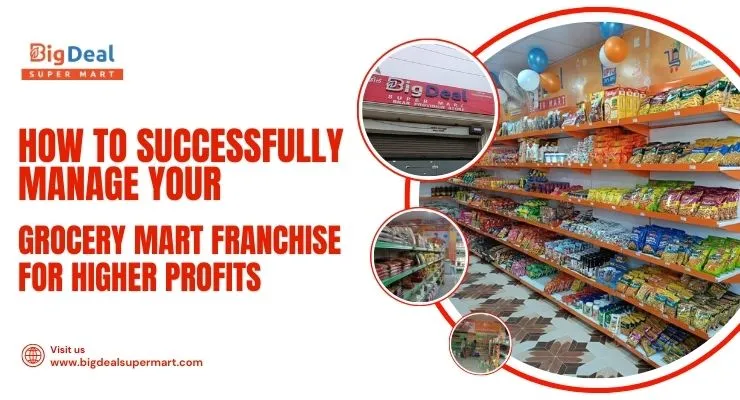
How to Successfully Manage Your Grocery Mart Franchise for Higher Profits
Running a Grocery Mart Franchise is not just a matter of opening up the place and hoping that customers will come in.
It is a business that incorporates operational strictness, human resource management, financial supervision, and customer service.
Although franchising gives you the advantage of a recognized brand and systems in place, still the long-term success is determined by your daily operation’s effectiveness and your ability to adapt to the local market.
A small inefficiency in India’s fast-moving retail environment can have a big impact on margins and customer loyalty.
A grocery mart that is well-managed not only sells goods but also gets people to consider it a nearby, already trusted place for their essentials, convenience, and value.

This guide will help you manage a grocery mart franchise from BigDeal in a very successful way with practical, real-world strategies that will maintain stability, growth, and profitability.
Understanding the Franchise Model and Your Responsibilities
Before getting into daily operations, it is first necessary to know exactly the franchisor’s part and what it will be.
The usual Grocery Mart Franchise gives branding, guidelines for the layout of the store, technology systems, vendor networks, and training.
The use of these systems implies you will follow the processes that are already tried and tested, but that does not mean you are no longer going to be managing hands-on.
You are going to be the one who has to hire, execute marketing locally, keep strict control of stock, and make sure that customers are satisfied with the service provided as well as the company’s financial situation.
The successful franchise operator always views the brand’s framework as the basis of the operation, not as a support.
The top stores in terms of performance are those in which the owners are taking a proactive role in everyday decision-making and problem-solving rather than relying exclusively on the use of automated systems or on the staff.
Also Read: Which Grocery Mart Franchise is Best in India?
Strong Inventory Discipline Building
Inventory, actually, is the heart of a grocery mart. When you have too much of it, the loss of it increases and capital is locked, while if you have too little stock, customers will be disappointed and they will go to the competitors.
Proper management of the inventory is the number one responsibility in the BigDeal grocery mart franchise.
Using the billing and inventory system that the franchisor provides enables you to keep an eye on the items that are moving fast, the patterns of the seasons, and the slow sellers.
No more demand guessing, just order based on real sales for that day. Essentials like milk, bread, snacks, and cooking oil should always be available, while niche products should be checked frequently for turnover.
Managing storage is just as important. The perishables should be controlled by temperature, expiry dates must be clearly marked, and FIFO (first in, first out) practices are the ones that reduce losses and sustain quality.
Stock audits, even small weekly ones, prevent silent shrinkage and theft.
Creating Uniform Customer Experience
A grocery mart franchise’s triumph is reliant on the customer’s trust in product availability, pricing fairness, and service quality being consistently developed.
In case the store aisles are clean, the shelves are organised, the signage is clear, and the staff is nice, they have a pleasant view of your store.
Customer return visits are not impacted by factors such as lighting, queue management at billing counters and staff hygiene standards. Considering customer feedback is mandatory at BigDeal franchises.
Complaints about product availability, pricing clarity, and staff behaviour should be listened to as they help to correct small problems before they grow into reputation issues.
Many successful franchise owners personally engage with regular customers to understand the changing preferences and local demand trends.
How to Manage Staff Performance in a Grocery Franchise
Retail is all about people. A motivated team is a prerequisite for the success of even the best systems.
A Grocery Mart Franchise generally needs cashiers, shelf stockers, cleaners, and possibly delivery workers.
The hiring of trustworthy personnel, coupled with their staying on, gives the company a cut in training and operational interruptions.
The clarification of roles enables the staff to know what they are accountable for. On the other hand, Regular training not only enhances the skill of customer interaction but also the billing accuracy and product handling.
Stable employees are a result of decent wages, predictable shifts, and small incentives for punctuality and performance.
The issue of high turnover not only lowers the quality of service offered but at the same time increases the hidden costs which are related to recruitment and retraining.
A workplace culture that fosters respect among all employees decreases conflicts as well as improves the customer-facing behaviours that directly affect sales and loyalty.
Maintaining Financial Control and Profitability
A Grocery Mart Franchise’s Profitability is through margin control, not only sales volume.
The daily reconciliation of billing, cash, digital payment, and inventory movement is a must. Retail environments are such that even tiny leakages gather fast.
Monitoring of the daily sales, gross margins, wastage percentage, and utility expenses as key metrics will help in making the problem visible early.
The electricity consumption for refrigeration, in particular, should be monitored closely. Rent, salaries, and vendor payments should be well-timed so as to avoid cash flow problems.
Putting back part of the monthly profit into maintenance, training the staff, and upgrading inventory that supports long-term growth is the opposite of the short-term withdrawals.
Effectively Leveraging Franchise Support
Centralised support is one of the main benefits that a Grocery Mart Franchise offers. Franchisors usually give marketing templates, vendor negotiations, seasonal promotions, and technical support.
The owners who form good relationships with the franchise managers get more benefits than those who do not.
The constant communication to the franchisor with regard to sales data, problems, and local market gives a better selection of the product and promotional planning.
Franchise reviews and audits ought to be viewed as not merely inspections but also as learning opportunities.
Technology Adoption for Smarter Operations
Modern retail technology removes the complexity. Billing systems monitor sales trends, send automatic reordering alerts, and show the different profit levels.
Many grocery marts have also added digital wallets, QR payments, and online ordering platforms which most consumers expect these days.
Besides this, WhatsApp ordering, home delivery coordinating, and digital inventory showing are some small technological advancements that offer convenience and, thus, help in being competitive.
Adapting to Local Market Dynamics
Each neighbourhood has its distinctive customer behaviour. For instance, a Grocery Mart Franchise located in a residential area will have a different sales pattern compared to one in an area of offices or dormitories.
The mix of products, sensitive price points, and the times of the day when shoppers are most active, change a lot from one place to another.
The practice of observing the customers, adapting the stock to their needs, and promoting in a localised manner is the way to go.
In fact, instead of following the generics of national trends, seasonal demand, festival buying patterns, and local preferences should guide the purchasing strategies.
Check out this: How To Choose The Right Grocery Mart Franchise in India
Managing Risk and Compliance
Regulatory compliance acts like a legal shield around the business. Among the things that need to be regularly done and systematically tracked are FSSAI license renewals, GST filings, hygiene audits, and fire safety compliance checks.
To a certain degree, the financial risk can be offset by insurance that encompasses the inventory, assets, and public liability.
Furthermore, the company has laid out its continuity plans in the face of such disruptions as power outages, supply chain delays, and personnel shortages.
Scaling the Business Sustainably
The next logical step after stabilizing operations is to grow them. Some franchisees choose to pour the earnings back into the establishment of the second or third outlet.
Nonetheless, before scaling, standardizing systems and document management processes is imperative to prevent chaos in operations.
Growth in multiple locations means an increase in purchasing power, brand presence, and profitability as long as the growth is implemented with care.
Conclusion
It demands continuous discipline and change to be successful in a Grocery Mart Franchise. Retail gives the rewards of systems in the long run and not of the short-term hacks.
A grocery mart franchise from BigDeal with organised management and thorough market knowledge can be a source of profits, scalability, and the like in business for years to come.
FAQs
Q1. How much time do grocery mart franchises usually take to earn their profits?
Most grocery mart franchises take about 6-9 months to get their operations running smoothly, then they will be at the break-even point in 12-24 months depending on various factors like location, rent, foot traffic, and inventory management.
Q2. What are the major daily challenges in running a grocery mart franchise?
The main problems are those about perishable stocks, staff, wastage, billing queues during peak hours, and product availability.
Q3. How significant is technology in managing a grocery mart franchise?
Technology is a significant factor in all areas, such as sales tracking, inventory management, billing error reduction, margin monitoring, and reordering. Even the most basic POS system increases accuracy and improves the quality of the management’s decision-making.
Q4. Are grocery mart franchises able to challenge online grocery platforms?
Yes. Local convenience, faster delivery, personal service, instant product availability are some of the advantages that keep physical grocery marts having loyal customers even if there is competition from online stores.
Q5. What are the skills for managing a grocery mart franchise to be successful?
Good people management, basic financial literacy, inventory planning, problem-solving ability, and customer relationship management are the key skills for success over the long term.