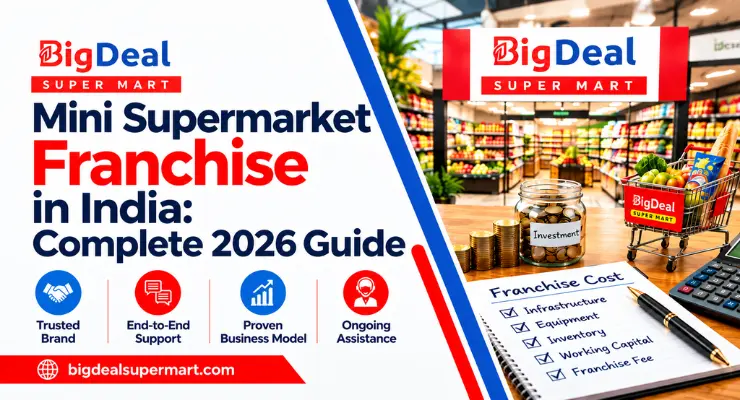
Mini Supermarket Franchise in India: Complete 2026 Guide
QUICK ANSWER
A BigDeal Supermart mini supermarket franchise needs a total investment of roughly ₹13 lakh for a 500 sq ft store up to ₹23 lakh for a 1,000 sq ft store. The model carries zero ongoing royalty on sales. Costs cover the franchise fee, a refundable security deposit, store interior, and opening inventory. Most franchisees reach break-even within 12 to 18 months of steady operations.
What Is a Mini Supermarket Franchise?
A mini supermarket franchise is a compact, self-service retail format that typically occupies 500 to 1,000 square feet of retail space.
It is designed for neighbourhoods, residential colonies, and smaller towns where a full-size hypermarket is not practical but shoppers still want the convenience of a self-service grocery and daily-needs store.
BigDeal Supermart’s mini format carries the same brand standards, product range philosophy, and operating systems as its larger stores, scaled down to a lower investment and a smaller footprint.
It is positioned as the entry point into the BigDeal Supermart franchise network for first-time retail entrepreneurs and for operators expanding into a second or third location.
Why Entrepreneurs Choose This Model
- Lower entry investment compared to supermarket or hypermarket formats
- Zero ongoing royalty on sales, which keeps monthly overhead predictable
- A recognised brand name and an established product and supplier network from day one
- Suitable for both new retail entrepreneurs and existing shop owners converting to a branded format
- A store size that fits residential colonies, tier-2 and tier-3 towns, and secondary neighbourhood markets in larger cities
Complete Investment Breakdown
The total investment scales with store size. The table below reflects the authoritative figures for this guide, confirmed as the most recently published and most itemised cost data available.
Investment by Store Size
| Store Size | Approximate Investment |
| 500 sq ft | ₹13,00,000 |
| 750 sq ft | ₹18,00,000 (approx.) |
| 1,000 sq ft | ₹23,00,000 |
Cost Component Breakdown
| Component | Approximate Cost |
| Franchise fee | ₹2,10,000 + GST |
| Security deposit (refundable) | ₹1,00,000 |
| Store interior and fixtures | ₹5,00,000 |
| Opening inventory / purchasing cost | ₹5,00,000 |
Figures above are approximate and vary with location, local construction costs, and the final store layout agreed with BigDeal Supermart. Always confirm current figures directly with the franchise team before signing any agreement.
Royalty and Ongoing Fees
The BigDeal Supermart mini supermarket franchise operates on a zero-royalty model: franchisees do not pay an ongoing percentage of sales back to the brand.
This is a central part of the format’s appeal, since it keeps monthly costs predictable and lets the franchisee retain a larger share of store-level profit.
As this figure directly affects a franchisee’s long-term economics, it should be verified in writing against the current franchise agreement before any investment decision is finalised.
Other BigDeal Supermart Formats
For entrepreneurs with a larger budget or a bigger retail space, BigDeal Supermart also offers larger store formats:
| Format | Approximate Investment |
| Super Mart | ₹23,00,000 – ₹83,00,000 |
| Hyper Mart | ₹83,00,000 – ₹2.3-2.4 crore |
Required Licences and Registrations
| Licence / Registration | Purpose |
| Shop and Establishment registration | Legal registration of the retail outlet |
| GST registration | Tax compliance for retail sales |
| FSSAI licence | Required for selling food and grocery items |
| Trade licence (local municipal body) | Permission to operate a commercial retail unit |
| Fire safety NOC | Mandatory for public retail premises |
Earnings Potential and Break-Even
Monthly revenue for a mini supermarket franchise format depends heavily on footfall, location, and product mix.
A well-run 500 to 1,000 sq ft store in a steady residential catchment typically builds toward consistent monthly turnover within the first year, with margins supported by the zero-royalty structure.
Most franchisees reach break-even within 12 to 18 months of stable operations, assuming consistent footfall and disciplined inventory management. Actual timelines vary by location and local competition.
Financing Options
- Self-funded investment from personal savings
- Business loans from nationalised and private banks
- MSME and small-business loan schemes for retail ventures
- Loans against property or other collateral, where available
Read More: Mini Supermarket Franchise Cost in India: Investment Breakdown for New Owners
Why a Franchise Outperforms an Independent Store
Opening an independent, unbranded grocery store means building supplier relationships, pricing systems, store design, and customer trust entirely from scratch.
A BigDeal Supermart franchise gives a new retailer an established brand identity, a tested store layout, vetted supplier and inventory systems, and ongoing operational support from the franchisor, which shortens the time it typically takes a new store to become profitable.
Staffing and Product Range
A typical 500 to 1,000 sq ft mini supermarket franchise is run with a small team of 2 to 4 staff members, covering billing, stocking, and customer service.
The product range spans daily groceries, packaged foods, personal care, household essentials, and select fresh items, curated to match the needs of a neighbourhood catchment.
Profit Maximisation Strategies
- Track fast-moving and slow-moving SKUs and adjust ordering weekly
- Build a local customer base through a simple loyalty or repeat-purchase approach
- Keep shelf layout and billing counter flow optimised for quick checkout
- Monitor wastage closely, particularly for perishable and fresh categories
- Use the zero-royalty margin advantage to reinvest in store presentation and stock depth
Day-to-Day Store Operations
Running a mini supermarket franchise on a daily basis involves a consistent rhythm: opening checks, stock replenishment, billing counter management, and closing reconciliation.
Franchisees who establish a clear daily routine from the first week tend to settle into stable operations faster than those who manage the store reactively.
- Morning stock check and shelf replenishment before peak footfall hours
- Billing counter staffing aligned with expected peak hours, typically evenings and weekends
- End-of-day cash and billing reconciliation against the point-of-sale system
- Weekly stock audit to identify fast-moving and slow-moving categories
Franchisees who review their point-of-sale reports weekly, rather than only at month-end, are generally able to catch stock-outs and overstocking issues early, before they affect sales or tie up working capital.
Seasonal and Festival Demand Planning
Grocery and daily-needs retail in India sees significant demand swings around major festivals and seasonal periods.
A mini supermarket franchise benefits from planning inventory and staffing around these periods in advance, since festival weeks can account for a disproportionate share of monthly revenue.
BigDeal Supermart franchisees are guided on seasonal product ranges and promotional stock, which helps smaller stores compete with larger retail formats during high-demand periods without overcommitting working capital outside the festival window.
Customer Experience in a Compact Format
In a 500 to 1,000 square foot store, customer experience depends heavily on a few fundamentals: product availability, a clean and organised layout, and a quick billing process.
Unlike a large-format store where customers may tolerate longer visits, mini supermarket shoppers are typically making frequent, short visits and expect speed and consistency.
Franchisees who prioritise keeping shelves stocked and the billing counter staffed during peak hours tend to build stronger repeat-visit habits among nearby households than those who focus primarily on store aesthetics alone.
Comparing the Mini Format to Opening a Branch Elsewhere
For an entrepreneur evaluating city options, the mini supermarket franchise format’s lower investment threshold means it can be deployed across a wider range of locations than a Super Mart or Hyper Mart, including smaller towns and secondary neighbourhoods within larger cities where a full-size format would not be financially viable.
This flexibility is one reason the mini format is often the entry point for franchisees who later expand into a Super Mart as their first location matures and demonstrates stable, repeatable footfall.
Common Challenges and How to Manage Them
Inventory and Wastage Management
Over-ordering perishable stock is one of the most common sources of avoidable loss in a mini supermarket franchise format.
A disciplined weekly ordering cycle, aligned to actual footfall data, keeps this under control. Franchisees who track wastage as a distinct line item, rather than folding it into general shrinkage, are better placed to spot which categories need tighter ordering discipline.
Local Competition
Independent kirana stores and other branded formats may already be present in a catchment area. A clean store layout, reliable stock availability, and consistent pricing are the most effective ways to build loyalty against this competition.
Rather than competing purely on price, franchisees are generally better served by competing on consistency: a shopper who can rely on finding what they need, every visit, tends to keep returning even if a competitor occasionally offers a slightly lower price.
Staff Turnover
Frontline retail staff turnover is common in this segment. Clear training on billing systems and customer handling from day one helps new staff become productive faster, and reduces the disruption to daily operations whenever a team member leaves.
Working Capital Management
Because opening inventory is one of the largest single cost components, new franchisees sometimes underestimate how much working capital is needed to keep shelves stocked through the first few months of operations, before sales stabilise.
Setting aside a buffer beyond the initial purchasing cost, rather than spending the full budget on store fit-out alone, helps avoid stock-outs in the critical early weeks.
Adapting Product Mix to the Local Catchment
A product range that performs well in one neighbourhood may not perform identically in another.
Franchisees who review their point-of-sale data regularly and adjust the local product mix accordingly, within the brand’s overall category guidelines, tend to see steadier sales growth than those who keep an unchanged range regardless of local demand patterns.
Location Selection: What Makes a Strong Site
Location is one of the biggest drivers of success for a mini supermarket franchise format. A residential colony with steady daily footfall, limited existing branded competition, and easy vehicle or walking access tends to outperform a site chosen purely on low rent.
- Visibility from the main road or colony entrance
- A catchment of at least a few hundred households within comfortable walking distance
- Adequate parking or two-wheeler stopping space outside the store
- Reasonable rent relative to the expected catchment size, rather than the cheapest available space
- Proximity to schools, offices, or residential societies that generate repeat daily footfall
BigDeal Supermart’s franchise team typically reviews proposed locations as part of the application process, which helps new franchisees avoid common site-selection mistakes before signing a lease.
Store Design and Layout Standards
The mini supermarket franchise format follows a standard layout designed to maximise product visibility and keep billing lines moving quickly.
Entry zones typically feature high-turnover items such as snacks and beverages, while staples, personal care, and household essentials are organised into clearly labelled aisles toward the rear of the store.
A consistent layout across all BigDeal Supermart outlets, regardless of city or store size, helps repeat customers navigate the store quickly even when visiting a different branch, which supports customer retention across the network.
Technology and Billing Systems
Each mini supermarket franchise is equipped with a point-of-sale billing system that tracks daily sales, stock movement, and basic inventory reporting.
This gives franchisees visibility into which products are moving fastest and which categories need reordering, without relying on manual stock counts.
A digital billing system also reduces checkout time during peak hours, which matters in a compact format where a slow billing counter can create queues that discourage repeat visits.
Marketing Support for New Franchisees
New franchisees typically receive guidance on local launch marketing, including store signage, an opening promotion, and basic neighbourhood outreach to build initial awareness.
Ongoing marketing in a mini supermarket format tends to rely heavily on consistent in-store experience and word of mouth within the local catchment, rather than large advertising spends.
- Store opening promotions to build initial footfall
- Seasonal and festival promotions aligned with local shopping patterns
- Simple local outreach such as flyers or community notices in the immediate catchment
- Consistent branding and signage that matches the wider BigDeal Supermart network
Franchisee Support from BigDeal Supermart
Beyond the initial setup, franchisees are supported with supplier access, product range guidance, and operational troubleshooting as the store settles into regular operations.
This ongoing support is one of the clearest advantages a branded franchise offers over opening an unbranded, independent store from scratch.
Who Should Consider This Franchise Format
The mini supermarket format is best suited to entrepreneurs who want to enter organised retail without committing to the larger investment and footprint of a Super Mart or Hyper Mart format.
It also works well for existing kirana or general store owners looking to convert to a branded, systemised operation.
- First-time retail entrepreneurs looking for a lower entry point into organised retail
- Existing shop owners converting an unbranded store into a recognised franchise format
- Investors seeking a second or third retail outlet with a proven operating model
- Family-run businesses looking to formalise and expand a local grocery operation
Check out this: How to Start a Supermarket Franchise in India
Getting Started
Opening a BigDeal Supermart mini supermarket franchise begins with an initial enquiry, followed by a review of the proposed location, a franchise agreement, store fit-out, staff onboarding, and a final readiness check before launch.
Prospective franchisees are encouraged to request the current franchise disclosure document and confirm all fee and royalty terms directly with the BigDeal Supermart franchise team before signing.
Taking the time to compare financing options, review the proposed location carefully, and verify every cost and royalty figure in writing puts a new franchisee in the strongest possible position before committing to the investment.
Frequently Asked Questions
4. How long does it take to break even?
he total investment for a BigDeal Supermart mini supermarket franchise? ” answer-0=”<span style=”font-weight: 400;”>The total investment ranges from approximately ₹13 lakh for a 500 sq ft store to ₹23 lakh for a 1,000 sq ft store, covering the franchise fee, security deposit, store interior, and opening inventory.</span><span style=”font-weight: 400;”> </span>” image-0=”” fontsize-0=”17″ fontunit-0=”px” count=”1″ html=”true”]
2. Does BigDeal Supermart charge an ongoing royalty?
3. How much space is required for this franchise format?
4. How long does it take to break even?
5. What licences are needed to open this franchise?
6. Can I finance my franchise investment with a loan?
7. How is the mini format different from the Super Mart or Hyper Mart format?
8. What kind of support does BigDeal Supermart provide after the store opens?