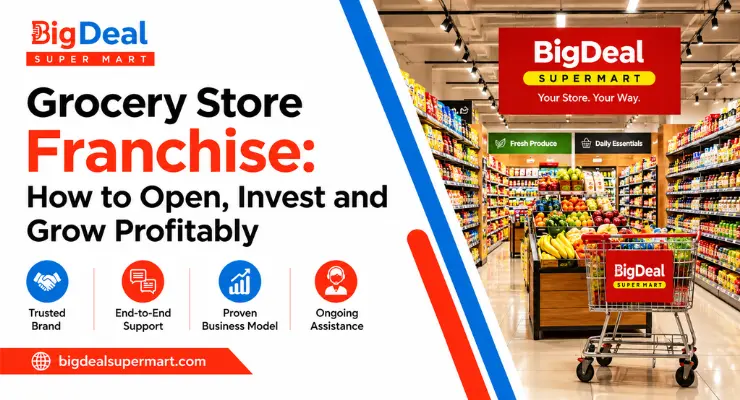
Grocery Store Franchise: How to Open, Invest and Grow Profitably
QUICK ANSWER
A grocery store franchise in India costs ₹13 lakh (Mini Mart) to ₹2.4 crore (Hyper Mart) with BigDeal Supermart – zero royalty on all formats. The opening process takes 45 days from agreement signing. Key success factors are location footfall, inventory discipline, and local digital marketing. The Indian grocery franchise market is growing at 10% annually with organised retail expected to capture 25% of total grocery sales by 2030. Apply for a BigDeal franchise.
Introduction
India’s grocery retail sector is undergoing the most significant transformation in its history.
The BigDeal Supermart franchise network is part of a ₹60 lakh crore grocery market that is shifting rapidly from unorganised kirana stores to branded organised retail, and the pace of that shift is accelerating.
For entrepreneurs who understand this opportunity, a grocery store franchise in India offers something rare: a business in a category that never experiences zero demand.
BigDeal Supermart is built on a proven operational system that eliminates the guesswork of starting from scratch.
This guide covers everything you need to know about opening a grocery store franchise in India in 2026: why the market is booming, what it costs by format, how to evaluate the right franchise partner, the exact steps to open your store, and the strategies that separate profitable franchise owners from those who break even for years.
Why Grocery Store Franchises Are Booming in India Right Now
The timing for entering the organised grocery retail market in India has rarely been better. Three structural forces are converging simultaneously to create a sustained demand window for organised grocery retail across all city tiers.
The Size of India’s Grocery Retail Opportunity
Organised grocery retail accounts for only 12% of India’s total grocery sales. The remaining 88% still flows through independent kirana stores, weekly markets, and unbranded vegetable vendors. By 2030, industry projections by IBEF estimate that organised retail will capture 25% of grocery sales – a ₹7.8 lakh crore expansion of the organised sector. Franchise store owners entering now are positioned at the front of that wave.
What Is Driving the Shift from Kirana to Organised Retail
- Quality assurance demand: Consumers are more conscious of product authenticity, expiry dates, and storage conditions. Organised franchise stores with FSSAI compliance and branded product guarantees address this; most kirana stores cannot
- One-stop shopping preference: The monthly grocery run has become a single-destination activity. A grocery store franchise stocking 2,000–20,000 SKUs enables this; a 200-SKU kirana cannot
- Digital payment normalisation: UPI and card payment acceptance is now a baseline expectation. Organised franchise stores offer full digital payment infrastructure
- Working women and dual-income households: As more women enter the workforce, one organised store covering all categories is the rational choice for time-constrained households
- Tier 2 and Tier 3 city urbanisation: Branded grocery shopping is now actively sought in cities like Indore, Surat, Jaipur, and Lucknow, not just metros
What Does It Cost to Open a Grocery Store Franchise in India?
Franchise cost in India varies significantly by brand, store format, and city. Understanding the full cost structure, not just the headline franchise fee, is essential before committing to any investment.
BigDeal Supermart Investment by Store Format
| Format | Store Size | Total Investment | Monthly Revenue Potential | Break-Even |
| Mini Mart | 500–1,000 sq ft | ₹13–23 lakh | ₹3–10 lakh/month | 12–18 months |
| Super Mart | 1,000–4,000 sq ft | ₹23–83 lakh | ₹10–25 lakh/month | 18–28 months |
| Hyper Mart | 4,000–10,000 sq ft | ₹83 lakh–₹2.4 crore | ₹25–80 lakh/month | 24–36 months |
| Royalty – all formats | – | – | – | ₹0 – Zero |
What Your Investment Actually Covers
- Franchise fee: One-time payment for brand usage rights, territory allocation, and documentation
- Store fit-out and shelving: Interior construction, flooring, lighting, shelving units, and signage
- Billing and inventory management software: Cloud-based POS with real-time stock tracking — included at no additional cost
- Initial stock: FMCG groceries, personal care, home care, beverages, and packaged foods
- Working capital (60 days): Buffer for rent, salaries, utility bills, and stock replenishment for the first two months
- Security deposit on rented premises: Typically 3–6 months of rent
- Legal registration fees: FSSAI license, GST registration, Trade License, and Shop and Establishment Act registration
| Working capital is the most underestimated cost. Many new franchise owners calculate only the franchise fee and fit-out, then run short on cash by week six when suppliers need payment and rent is due. Budget the full investment range and maintain a minimum 60-day operating expense buffer after opening. |
How to Choose the Right Grocery Store Franchise in India
Not every franchise in India offers the same value. Choosing the wrong franchisor costs you capital, market position, and years of growth potential. These four criteria consistently separate strong franchise opportunities from weak ones.
Four Criteria That Matter Most
1. Royalty structure: zero vs. ongoing percentage
The single most important financial term in any franchise agreement. Some brands charge 3–6% of monthly revenue as an ongoing royalty. On ₹10 lakh monthly revenue, a 4% royalty is ₹40,000 per month – ₹4.8 lakh per year. Ask for the royalty clause in writing before any investment discussion.
2. Supply chain quality and supplier access
A franchise’s supply chain determines your product margins. A strong franchisor with direct agreements from FMCG manufacturers gives you better procurement pricing than an independent store could negotiate in its first three years.
3. Exclusive territory rights
Without a written exclusive territory clause, your franchisor can open another partner’s store in the same locality, directly competing for your customers. Confirm the exact geographic boundary in the franchise agreement.a
4. Post-opening support model
Ask specifically: Are there quarterly business reviews? Is there a dedicated support contact for operational issues? A franchisor that disappears after you sign gives you a brand, not a system.
Why BigDeal Supermart’s Zero-Royalty Model Stands Out
BigDeal Supermart is one of the few established brands offering zero royalty across all store formats. The comparison below shows the 36-month financial difference for a franchise generating ₹8 lakh monthly revenue:
| Royalty Model | Monthly Royalty | 36-Month Total |
| 3% royalty competitor | ₹24,000 | ₹8.64 lakh |
| 4% royalty competitor | ₹32,000 | ₹11.52 lakh |
| 5% royalty competitor | ₹40,000 | ₹14.40 lakh |
| ₹0 – BigDeal Supermart (zero royalty) | ₹0 | ₹0 saved |
How to Open a Grocery Store Franchise in India: Step by Step
Step 1: Location Selection and Site Survey
- Residential density: Minimum 500 households within 500 metres. Apartment complexes, gated communities, and residential colonies are ideal
- Footfall count: 200+ people per hour during peak times (weekday 6–9 PM and Sunday morning) is a baseline indicator
- Road visibility: Store entrance visible from the main road without relying on signage alone
- Competition within 1 km: Note every grocery store and supermarket. Proximity to large chains is workable with a differentiation strategy
- Parking access: Space for 8–10 two-wheelers and 2–3 cars minimum for a Mini Mart
Step 2: Legal Requirements Before Opening
| Registration | Authority | Timeline | Approx. Cost |
| FSSAI State License | Food Safety and Standards Authority of India | 30–45 days | ₹2,000–₹5,000 |
| GST Registration | Goods and Services Tax portal (gstin.gov.in) | 7–15 days | No fee |
| Trade License + Shop and Establishment Act | Local Municipal Corporation + State Labour Dept. | 15–30 days | ₹500–₹5,000 |
Apply for all three simultaneously. FSSAI has the longest processing time – start it first. BigDeal’s operations team provides documentation guidance during onboarding, significantly reducing errors and resubmissions.
Step 3: The 45-Day Setup Process
- Week 1–2: Site fit-out begins. Flooring, shelving, electrical, and branding installation. Billing software configured and tested
- Week 2–4: Staff recruitment and 4-week training programme. Initial stock order placed and confirmed with BigDeal’s procurement team
- Week 5–6: Initial stock arrives and placed on shelves per planogram. Pre-opening quality check by BigDeal’s operations team
- Day 45: Grand opening. Opening offer communicated to 1.5 km radius via flyers, WhatsApp groups, and social media
Strategies to Grow Your Grocery Store Franchise After Opening
Inventory and Pricing Strategies That Protect Your Margin
Weekly dead stock audit: Every SKU not moved in 30 days ties up working capital. Review the dead stock report from your billing software every Monday
- Category margin mapping: Staple groceries carry 10–16% margins. Personal care and home care carry 20–25%. Ensure high-margin categories occupy 25–30% of shelf space
- Festival stock planning (4 weeks ahead): Diwali, Navratri, Eid, and regional festivals consistently deliver 30–50% higher monthly revenue. Place your festival stock order 4 weeks before each event
- Restocking alert discipline: Set restocking alerts at 5–7 days above the projected stock-out date, not at zero
Customer Retention Tactics for Your Locality
- Loyalty stamp card: ₹10,000 in cumulative purchases earns a ₹200 credit. At that spend, the customer has already generated ₹1,600–₹2,000 in gross profit – the ₹200 redemption is a 10–12% loyalty cost on that profit
- Monthly family account: Allow regular bulk-shopping households to maintain a running account settled at month end. This removes payment friction and creates switching costs
- Birthday offer: Collect customer birthdays. Send a WhatsApp message with a 5% discount for their birthday week. The memory of being remembered builds loyalty disproportionate to the cost
Digital Marketing for Your Grocery Store Franchise
- Google Business Profile: Claim and complete your GBP listing in Week 1. A store with a complete listing and 20+ reviews consistently ranks in the top 3 for ‘grocery store near me’ in its locality
- WhatsApp Business weekly offer: One post per week in residential colony groups every Monday morning. Stores posting consistently for 90 days report 20–40 additional monthly orders from this channel
- Instagram weekly content: 3 posts per week with your locality’s name in every caption. Target 50–100 local followers in the first 90 days
Mistakes to Avoid When Opening a Grocery Store Franchise in India
| Mistake | Impact | Fix |
| Choosing location based on low rent rather than high footfall | 40% less daily traffic means significantly lower revenue regardless of operations quality | Count foot traffic for 3 days during peak hours. Pay for the right location. |
| Opening with 60% of planned SKUs to save initial cost | First-visit customers see empty shelves and do not return — permanent reputation damage | Spend the full initial stock budget. A well-stocked opening day creates customer confidence. |
| Hiring staff without structured pre-opening training | Billing errors, stock misplacement, and inconsistent customer handling from Day 1 | Complete BigDeal’s 4-week training for all staff before serving a single customer. |
| No digital presence for the first 3 months | In 2026, most first-time grocery franchise visitors discover the store on Google Maps or WhatsApp first | Set up Google Business Profile, WhatsApp Business, and Instagram before opening day. |
| Underestimating working capital requirement | Cash shortage by week 6 when rent and supplier payments are due simultaneously | Budget 60–90 days of fixed operating expenses as a non-negotiable reserve before opening. |
Frequently Asked Questions About Grocery Store Franchises in India
What is the minimum investment to open a grocery store franchise in India?
Does BigDeal Supermart charge ongoing royalty on a grocery store franchise?
How long does it take to open a BigDeal grocery store franchise from agreement signing?
Is a grocery store franchise profitable in Tier 2 and Tier 3 cities in India?
What are the legal requirements to open a grocery store franchise in India?
What profit margin does a grocery store franchise in India generate?